



Digital Marketing Roadmap for MBA Students in 2026

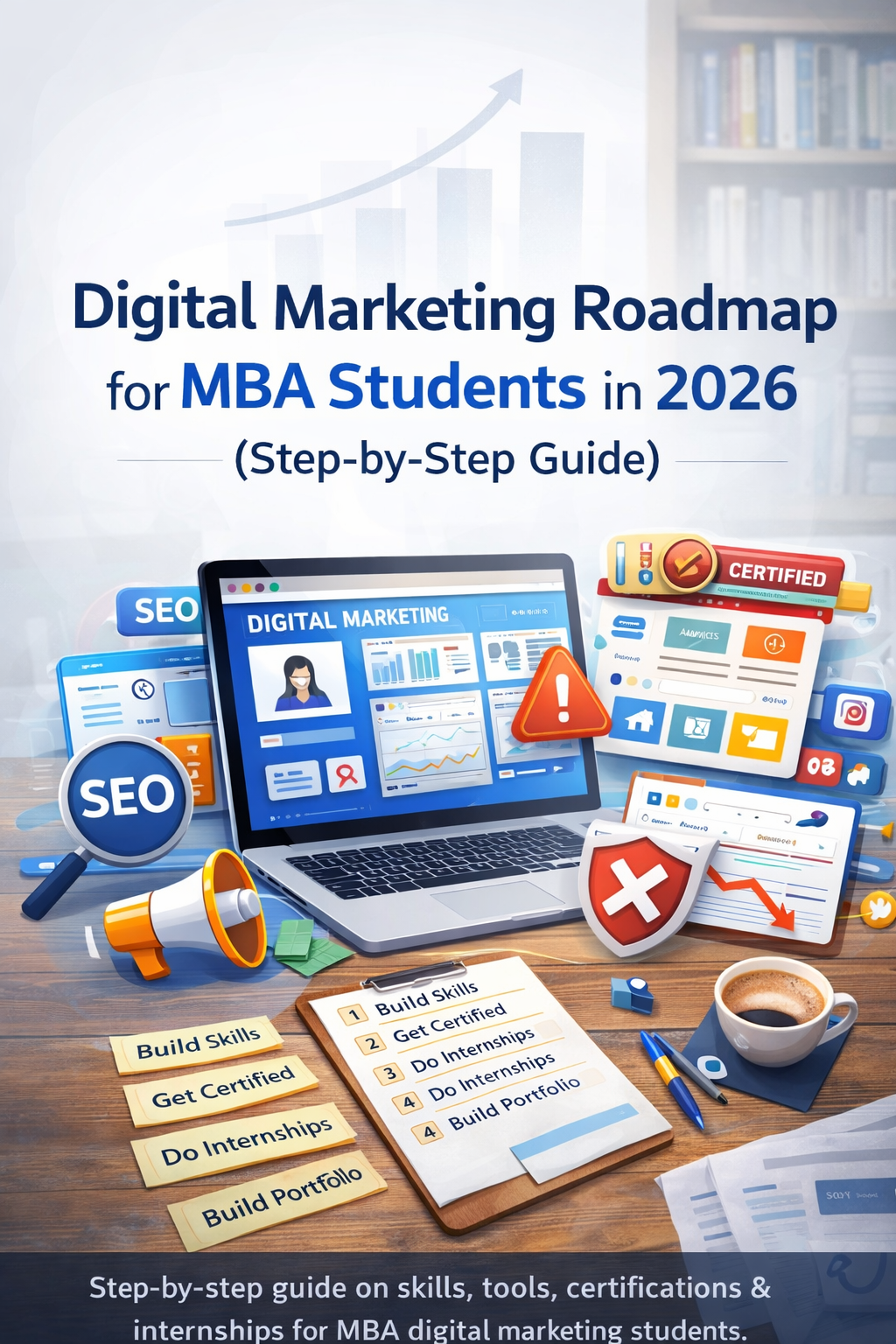
Digital marketing roadmap for MBA students in 2026 showing SEO, analytics, certifications, internships and portfolio building steps.

Digital marketing is no longer optional for MBA students — it is a career necessity. In 2026, companies expect MBA graduates to not only understand marketing theory but also execute real digital strategies. If you are an MBA student specializing in marketing and wondering: What skills should I learn? Which tools should I master? How do I start my career in digital marketing? How can I stand out in interviews? This complete digital marketing roadmap for MBA students will guide you step by step. Why MBA Students Need a Digital Marketing Roadmap in 2026 The job market is competitive. Recruiters now look for: Practical skills Tool knowledge Analytical thinking Portfolio proof Real project experience Just having an MBA degree is not enough. You must combine academic knowledge with digital execution skills. This roadmap will help you move from classroom learning to industry readiness. Step 1: Build Strong Marketing Fundamentals Before jumping into tools and ads, you must understand marketing basics. Focus on: STP (Segmentation, Targeting, Positioning) Consumer behavior Marketing funnel (Awareness → Consideration → Conversion) 4Ps & 7Ps of marketing Branding concepts Digital marketing is simply marketing applied online. Without fundamentals, tools won’t help. Step 2: Learn Core Digital Marketing Skills Now comes the practical part. 1. Search Engine Optimization (SEO) SEO helps websites rank on Google. Learn: Keyword research On-page SEO Meta tags Internal linking Technical basics Google Search Console SEO is one of the most important skills for MBA digital marketing students. 2. Performance Marketing (Paid Ads) Companies spend heavily on ads. Learn: Meta Ads Google Ads Budget allocation Campaign structure A/B testing ROAS calculation Understanding ad performance makes you highly employable. 3. Content Marketing Content builds brand authority. Learn: Blog writing Content strategy SEO content writing LinkedIn content Copywriting basics Good content skills improve both branding and conversions. 4. Social Media Marketing Understand: Platform strategy Content calendar Engagement metrics Reels strategy Audience insights Focus on strategy, not just posting. 5. Marketing Analytics This is where MBA students can truly stand out. Learn: Google Analytics Conversion tracking Data interpretation Excel basics KPI analysis Companies value marketers who understand numbers. According to Google Search Central, high-quality content and proper on-page optimization are key factors in ranking on search engines. Step 3: Tools Every MBA Student Should Learn in 2026 Here are must-learn tools: Google Analytics Google Search Console SEMrush or Ubersuggest Meta Ads Manager Google Ads Canva Excel Power BI (optional but powerful) Tool knowledge increases your confidence in interviews. Step 4: Build a Strong Digital Marketing Portfolio Your portfolio is proof of your skills. Include: SEO projects Blog content Ad campaign samples Case studies Strategy documents Analytics reports Even if you don’t have clients, create mock projects. While building your portfolio, make sure you avoid common errors. I’ve explained the most common Portfolio Website Mistakes that students make and how to fix them. Step 5: Do Internships (Even Without High Stipend) Practical experience matters more than short-term money. During internships: Ask questions Volunteer for extra tasks Learn reporting formats Understand client communication Track your performance metrics Every internship adds real credibility to your profile. Step 6: Build Personal Branding on LinkedIn In 2026, personal branding is powerful. Post about: What you’re learning Case studies Marketing insights Industry trends Internship experiences Consistency builds visibility. Recruiters often check LinkedIn before shortlisting candidates. Step 7: Earn Relevant Certifications You don’t need 20 certificates. Focus on: Google Analytics certification Google Ads certification HubSpot content marketing Meta Blueprint Certificates support your resume but skills matter more. Step 8: Learn How to Think Strategically MBA students should think like strategists, not just executors. Practice: Competitor analysis SWOT analysis Funnel planning Campaign budgeting Market research Strategic thinking differentiates you from regular digital marketers. Step 9: Develop Soft Skills Technical skills are important, but soft skills close the deal. Work on: Communication Presentation skills Reporting clarity Time management Team collaboration Corporate marketing roles require professionalism. Final Digital Marketing Roadmap Summary (Checklist) ✔ Build marketing fundamentals✔ Learn SEO and paid ads✔ Understand content strategy✔ Master analytics✔ Learn important tools✔ Build portfolio✔ Do internships✔ Build personal brand✔ Earn certifications✔ Improve soft skills Follow this roadmap consistently for 6–12 months, and you will be industry-ready. Final Thoughts The digital marketing field is growing rapidly, and MBA students who combine strategy with execution will always stay ahead. If you start early, stay consistent, and focus on practical skills, you can build a strong and successful digital marketing career in 2026. Your MBA degree gives you strategic thinking. Digital skills give you industry power. The right combination makes you unstoppable. FAQs 1️⃣ What is the best digital marketing roadmap for MBA students? The best digital marketing roadmap for MBA students starts with building strong marketing fundamentals like STP, branding, and consumer behavior. After that, students should learn core digital skills such as SEO, paid advertising, content marketing, social media strategy, and marketing analytics. The next step is mastering tools like Google Analytics and Meta Ads Manager, followed by building a portfolio website and gaining internship experience. Consistent practice and personal branding on LinkedIn can make MBA students industry-ready within 6–12 months. 2️⃣ Which digital marketing skills should MBA students learn in 2026? In 2026, MBA students should focus on practical and data-driven digital marketing skills. These include Search Engine Optimization (SEO), performance marketing (Google Ads and Meta Ads), content strategy, social media marketing, email marketing, and marketing analytics. Understanding campaign performance metrics like CTR, conversion rate, and ROAS is also important. Along with execution skills, MBA students should develop strategic thinking and problem-solving abilities to stand out in competitive job markets. 3️⃣ Is digital marketing a good career option after MBA? Yes, digital marketing is one of the fastest-growing and high-demand career options after an MBA. Companies today need professionals who understand both marketing strategy and digital execution. MBA graduates with digital skills can apply for roles such as Digital Marketing Executive, SEO Analyst, Performance Marketer, Content Strategist, or Growth Manager. The field offers strong career growth, competitive salaries, and … Read more

Digital Marketing Skills Every MBA Student Must Learn in 2026

digital marketing skills for mba students in 2026

Digital marketing is no longer an optional skill for MBA students—it is a career necessity. In 2026, companies expect MBA graduates to understand not just marketing theory, but also how digital strategies work in real-world scenarios. As an MBA student specializing in Digital Marketing, I’ve realized that recruiters today focus more on practical skills, strategic thinking, and execution ability than just degrees. This blog covers the most important digital marketing skills every MBA student must learn in 2026 to stay competitive and job-ready. Why Digital Marketing Skills Matter for MBA Students in 2026 The marketing landscape is evolving rapidly due to: AI-driven tools Data-based decision making Changing consumer behavior Increased competition in digital channels MBA students who combine management knowledge with digital marketing skills gain a clear advantage in roles like: Digital Marketing Executive Marketing Strategist Growth Marketer Brand Manager Performance Marketing Analyst In 2026, employers are not just hiring marketers—they are hiring problem solvers who understand digital ecosystems. Core Digital Marketing Skills MBA Students Must Learn 1. Search Engine Optimization (SEO) SEO remains one of the most valuable long-term skills in digital marketing. MBA students should understand: Keyword research & search intent On-page SEO fundamentals Technical SEO basics Content optimization Google Search Console insights SEO teaches patience, data analysis, and strategy—skills every marketer needs. 2. Content Marketing Strategy Content is not about posting randomly; it’s about solving audience problems. A strong content marketing strategy helps brands attract, engage, and convert the right audience. Key skills include: Content planning & calendars Blog and website content structure Brand storytelling Content for different funnel stages Performance measurement This skill directly connects with customer psychology and brand positioning, which MBA students already study. 3. Social Media Marketing In 2026, social media is less about trends and more about strategy and consistency. MBA students should learn: Platform-specific strategies Audience targeting Content formats that convert Analytics and engagement tracking Personal branding on LinkedIn & Instagram Understanding social media also improves brand communication skills. 4. Email Marketing & CRM Basics Despite new platforms, email marketing remains one of the highest ROI channels. Important skills: Email funnel creation Lead nurturing Segmentation Basic CRM understanding Campaign performance analysis This aligns perfectly with MBA concepts like customer retention and relationship management. 5. Performance Marketing Fundamentals MBA students don’t need to master ads immediately, but understanding the basics is crucial. Learn: Google Ads & Meta Ads overview Budget allocation logic KPIs like CPC, CTR, ROAS Conversion tracking A/B testing concepts This builds analytical and financial thinking, a strong MBA advantage. Strategic Skills Recruiters Look for in MBA Students 6. Customer Psychology & Buying Behaviour Understanding why customers behave the way they do is a core MBA strength. Digital marketing applications include: Funnel optimization Messaging strategies Content personalization Conversion improvement This skill bridges theory with execution. 7. Marketing Analytics & Data Literacy In 2026, marketing decisions are data-driven. MBA students should understand: Google Analytics 4 basics Campaign performance reports User behavior analysis ROI calculation Data-backed decision making Recruiters value marketers who can explain numbers clearly. 8. Campaign Planning & Strategy Digital tools are useless without strategy. This includes: Setting marketing objectives Choosing the right channels Planning timelines Measuring outcomes Optimizing campaigns This is where MBA strategic thinking truly shines. Tools Every MBA Student Should Learn in 2026 Practical exposure matters as much as theory. MBA students should be comfortable with: Google Analytics 4 Google Search Console WordPress & Elementor Canva AI tools for content & research Basic SEO tools Tool knowledge strengthens your portfolio and interview confidence. How I’m Building These Skills Practically Instead of only learning theory, I focus on hands-on application by: Building and optimizing my own portfolio website Writing SEO-focused blog content Planning digital strategies for real scenarios Tracking performance using analytics tools This practical approach helps convert learning into proof, which recruiters value. To understand this better, you can check: How I Built My Digital Marketing Portfolio Website andHow I Planned and Executed a Digital Marketing Strategy for My Portfolio Website Common Mistakes MBA Students Make in Digital Marketing Many MBA students: Rely only on certificates Ignore portfolio building Focus on tools without strategy Avoid data and analytics Don’t document their learning Avoiding these mistakes early can accelerate career growth. To understand this better, you can check: Portfolio Website Mistakes Digital Marketing Students Should Avoid Final Thoughts: Skills Matter More Than Degrees in 2026 In 2026, an MBA degree alone is not enough. What truly matters is: Your skill set, Your ability to apply concepts, and Your willingness to learn continuously. By mastering these digital marketing skills, MBA students can position themselves as strategic marketers, not just job seekers. FAQs Q1. Are digital marketing skills necessary for MBA students in 2026?Yes. Digital skills significantly improve employability and career growth. Q2. Can MBA students learn digital marketing without prior experience?Absolutely. With the right strategy and practice, beginners can build strong expertise. Q3. Which digital marketing skill is most important for MBA students?SEO, analytics, and strategy understanding are the most valuable long-term skills.

Portfolio Website Mistakes Digital Marketing Students Should Avoid

Common portfolio website mistakes digital marketing students should avoid

Creating a digital marketing portfolio website is an essential step, but many students make digital marketing portfolio website mistakes that reduce its impact of their work, but by focusing on strategy, clarity, and real projects, these mistakes can easily be avoided. After building my own portfolio website and reviewing many student portfolios, I’ve realized that a strong portfolio is not about doing everything—it’s about doing the right things clearly and honestly. Below are the most common digital marketing portfolio website mistakes students make and practical tips to avoid these portfolio website mistakes. 1. Trying to Look Like an Experienced Professional One of the biggest mistakes students make is pretending to have years of industry experience. Adding fake job roles or exaggerating skills might look impressive at first, but recruiters can easily spot this. Instead, present yourself confidently as a student or fresher. Highlight internships, academic projects, certifications, and self-initiated work. Authenticity builds trust and shows a genuine learning mindset. 2. Focusing Too Much on Tools, Not Strategy Many portfolios list multiple tools but fail to explain how they were used strategically. Tools alone do not make you a good digital marketer—your thinking does. Recruiters want to understand: Why you chose a particular strategy How you planned your content or SEO What problem you were trying to solve I’ve explained my own approach in digital marketing strategy for my portfolio website, where I detail how planning and execution matter more than just tools. 3. Overdesigning the Website A visually attractive website is good, but overdesigning it can distract from your content. Heavy animations, unnecessary sections, and cluttered layouts often confuse visitors. A strong digital marketing portfolio website should be: Simple and easy to navigate Mobile-friendly Fast-loading Content-focused Clean design reflects clarity of thought, which is essential in marketing roles. 4. Ignoring SEO Basics Another common mistake is not applying basic SEO to the portfolio website itself. If you claim to know digital marketing, your own website should reflect that knowledge. Ignoring SEO basics such as: Proper headings Optimized titles Internal linking Image alt text can weaken your portfolio’s credibility. Even basic SEO implementation shows practical understanding. 5. Not Showcasing Real or Practical Work Some students focus only on theory and certifications but forget to showcase actual work. Recruiters look for proof of application, not just learning. Practical work can include: Blogs or content samples Website creation or optimization Case-study style projects Strategy planning documents Even self-initiated projects add value when explained clearly. 6. Missing Clear Positioning Many student portfolios fail to clearly communicate what the student wants to specialize in. If everything is mentioned, nothing stands out. Your portfolio should clearly answer: Are you more interested in SEO, content, social media, or analytics? What kind of roles are you targeting? Clear positioning helps recruiters quickly understand your profile. 7. Not Sharing the Learning Journey A major mistake is only showing results without explaining the learning process. Recruiters appreciate growth, reflection, and self-awareness. I’ve shared this in detail in my post on lessons I learned while building my portfolio website, where I reflect on challenges, mistakes, and improvements made during the process. 8. Making It Hard to Contact You Surprisingly, many portfolios hide or complicate contact information. No matter how good your portfolio is, recruiters should be able to reach you easily. Always ensure: Resume is easy to download Contact details are visible Navigation is simple A strong portfolio encourages action. Final Thoughts Creating a digital marketing portfolio website is not about being perfect—it’s about being clear, honest, and practical. Most mistakes happen when students try to impress instead of communicate. By avoiding these common mistakes and focusing on strategy, clarity, and real learning, students can build portfolio websites that truly stand out and reflect their potential. Your portfolio should not just show what you know—it should show how you think.

What Makes a Strong Digital Marketing Portfolio Website

strong digital marketing portfolio website for students

As a Digital Marketing student, your portfolio website is more than just an online resume. It is proof of your skills, thinking ability, and practical understanding of marketing. In a competitive job market, especially for freshers, a strong portfolio website can become your biggest advantage. After planning, building, and optimizing my own digital marketing portfolio website, I realized that recruiters don’t look for perfection—they look for clarity, relevance, and intent. From a student’s perspective, here’s what truly makes a digital marketing portfolio website strong and impactful. 1. Clear Purpose from the First Scroll A strong portfolio website immediately answers three questions: Who are you? What do you do? Why should someone hire you? Your homepage should clearly state that you are a Digital Marketing student or fresher, along with your key interests such as SEO, content marketing, social media, or analytics. Avoid vague statements. Simplicity and clarity matter more than fancy design. Recruiters spend very little time initially, so if your purpose is not clear within the first few seconds, they may not explore further. 2. Student Positioning, Not Fake Experience One common mistake students make is trying to look like industry experts with years of experience. A strong portfolio embraces the student identity but presents it professionally. Instead of pretending to have years of experience: Highlight internships, live projects, certifications, and self-learning Explain what you learned and how you applied concepts practically Be honest and confident about being in the learning phase Recruiters appreciate transparency and growth mindset more than exaggerated claims. 3. Real Projects and Practical Work A strong digital marketing portfolio website focuses on what you have done, not just what you know. This can include: Personal website or blog SEO-optimized content you’ve written Social media strategies or sample calendars Campaign ideas or case-study-style projects Website planning, execution, and optimization process Even if projects are self-initiated, explain your approach, objectives, and learnings. Practical exposure—no matter how small—adds credibility. 4. Strategic Thinking Over Tools Knowing tools is important, but what truly makes a portfolio strong is how you think as a marketer. Recruiters look for answers to questions like: Why did you choose a particular strategy? How did you plan your content or SEO structure? What was your logic behind targeting a specific audience? When you explain your decisions clearly, it shows marketing maturity. Tools can be learned, but strategic thinking takes time—and that’s what sets strong portfolios apart. A strong portfolio reflects strategic thinking, not just tool knowledge. Every decision—from content structure to targeting—should have a clear purpose. I’ve explained my approach in detail in digital marketing strategy for my portfolio website, where I share how I planned and executed the strategy step by step. 5. Simple, Clean, and Mobile-Friendly Design Design doesn’t need to be complex to be effective. A strong portfolio website: Is easy to navigate Loads quickly Looks good on mobile devices Uses readable fonts and consistent colors Cluttered layouts and over-designed pages distract from your content. Clean design reflects clarity of thought, which is extremely important in marketing roles. 6. SEO Basics Applied Correctly You don’t need advanced SEO, but applying basic SEO principles strengthens your portfolio. This includes: Clear page titles and headings Relevant keywords used naturally Proper internal linking between blogs Optimized images with alt text Applying SEO to your own website shows that you don’t just learn concepts—you implement them. 7. Learning Journey and Growth Mindset A strong student portfolio shows progress, not just final outcomes. Blogs or sections where you share: Lessons learned while building your website Mistakes you made and how you fixed them How your understanding of digital marketing evolved This reflects curiosity, self-awareness, and willingness to improve—qualities recruiters genuinely value. I’ve shared some of these experiences in detail in my post on lessons I learned while building my portfolio website, which highlights practical challenges and key takeaways from the process. 8. Easy Access to Resume and Contact Details No matter how good your content is, your portfolio should make it easy for recruiters to reach you. Ensure that: Your resume is easily accessible Contact information is visible Social or professional profiles are linked (if relevant) A strong portfolio always encourages the next step—connection. Final Thoughts From a student’s perspective, a strong digital marketing portfolio website is not about being perfect or pretending to be an expert. It’s about showing intent, effort, learning, and strategic thinking. When your portfolio clearly reflects who you are, what you’ve learned, and how you apply marketing concepts in real scenarios, it naturally stands out. For students and freshers, authenticity combined with clarity is the real strength. Your portfolio is your story—make sure it tells the right one.

Digital Marketing Portfolio Website Checklist for Students (2026 Edition)

Digital marketing portfolio website checklist for students 2026 edition

In 2026, having skills listed on a resume is no longer enough for digital marketing students. Recruiters, agencies, and clients want to see proof of your skills, and that’s exactly where a digital marketing portfolio website becomes essential. Your portfolio website is more than a collection of pages — it’s your personal brand, your digital resume, and your live case study. This checklist will help you ensure your portfolio website is professional, recruiter-friendly, SEO-optimized, and future-ready. 1. Personal Branding Checklist Your portfolio should clearly communicate who you are and what you do within the first 5 seconds. ✔ Your name is clearly visible✔ You have a clear headline (e.g., Digital Marketing Student | SEO & Content Strategy)✔ A short about section explaining your interests and strengths✔ Professional profile photo (optional but recommended)✔ Consistent color scheme and typography Tip: Avoid generic lines like “passionate digital marketer”. Be specific. 2. Homepage Content Checklist Your homepage should act as a landing page for recruiters. ✔ Clear value proposition✔ Brief introduction (who you are + what you do)✔ Quick access to portfolio/projects✔ CTA (Contact Me / View Projects / Download Resume)✔ Clean and uncluttered layout Think like a marketer: your homepage should convert visitors into opportunities. 3. Portfolio / Projects Section Checklist This is the most important section of your website. ✔ Real projects (academic, personal, freelance, or internship-based)✔ Clear project title and objective✔ Tools used (SEO, Google Analytics, Canva, Meta Ads, etc.)✔ Strategy explained (not just results)✔ Screenshots or visuals✔ Key learnings from each project Even self-initiated projects matter more than fake certifications. 4. Skills Section Checklist Your skills should reflect practical knowledge, not buzzwords. ✔ Categorized skills (SEO, Content, Analytics, Social Media, Ads)✔ Tools you’ve actually used✔ Avoid listing too many skills✔ Mention beginner/intermediate/advanced where relevant Quality > quantity always wins. 5. Blog Section Checklist (Highly Recommended) Blogs show your thinking process and expertise. ✔ Marketing-related blogs only✔ Personal learning experiences✔ SEO-optimized titles✔ Internal links between blogs✔ Consistent posting (even once a month is enough) Blogs turn your portfolio into a knowledge hub, not just a showcase. 6. SEO Optimization Checklist A digital marketer’s portfolio must be SEO-friendly. ✔ SEO-friendly URLs✔ Focus keyphrase per page✔ Meta title & meta description added✔ Optimized images with alt text✔ Internal linking✔ Website indexed on Google Search Console Ranking your own website is the best proof of SEO skills. 7. Technical Checklist Your website should work smoothly across all devices. ✔ Mobile-responsive design✔ Fast loading speed✔ SSL certificate (HTTPS)✔ Working contact form✔ No broken links A slow or broken website can ruin first impressions instantly. 8. UX & UI Checklist Good design improves user experience and trust. ✔ Simple navigation menu✔ Readable font sizes✔ Enough white space✔ Consistent design across pages✔ Clear section hierarchy Your website should look professional, not overcrowded. 9. Resume & Contact Checklist Make it easy for recruiters to reach you. ✔ Downloadable resume✔ Contact form✔ Email address visible✔ LinkedIn profile link✔ Optional: Instagram or GitHub (if relevant) Never make visitors search for your contact details. 10. Final Review Checklist Before Publishing ✔ No spelling or grammar errors✔ All buttons and links working✔ Updated content✔ Real information only✔ Personal touch included Review your site as if you’re a recruiter visiting it for the first time. 🌟 Final Thoughts A digital marketing portfolio website in 2026 is not about perfection — it’s about clarity, authenticity, and proof of skills.Start small, improve consistently, and let your website grow along with your career. Your portfolio should tell one clear story: 👉 You understand digital marketing because you practice it.

How I Planned and Executed a Digital Marketing Strategy for My Portfolio Website

Digital marketing strategy for personal portfolio website

Building my portfolio website was not just about creating an online resume — it was a strategic digital marketing project. As a digital marketing student, I treated my portfolio as a brand, my skills as products, and recruiters as my target audience. This blog explains how I planned and executed a complete digital marketing strategy for my portfolio website. 1. Defining the Objective The first step in my strategy was setting clear goals.The primary objectives of my portfolio website were: To showcase my digital marketing skills and projects To build a strong personal brand To attract recruiters, internship opportunities, and industry professionals To demonstrate my strategic thinking, not just technical skills Having clear objectives helped me make informed decisions throughout the process. 2. Identifying the Target Audience Understanding the target audience is crucial in any marketing strategy.For my portfolio website, the target audience included: Recruiters hiring for digital marketing roles Marketing managers and agencies Professionals reviewing student portfolios Fellow students and learners This influenced my content tone, design layout, and the type of projects I highlighted. 3. Website Structure and Content Strategy I structured my website to provide a smooth and user-friendly experience.The key sections included: Home: Clear introduction and value proposition About Me: Academic background, skills, and career goals Portfolio/Projects: Real-world examples, case studies, and tools used Blog: Demonstrating knowledge, learning experiences, and strategy Contact: Simple and accessible call-to-action Each section was designed to guide the visitor logically through my profile. 4. SEO Strategy Implementation Search Engine Optimization (SEO) was a major part of my strategy. I focused on basic but effective SEO practices, such as: Keyword research related to digital marketing and student portfolios Optimizing page titles, headings, and meta descriptions Using internal linking between blogs and pages Writing SEO-friendly blog content with proper formatting Optimizing images and improving page loading speed This helped improve visibility and made my website more discoverable. 5. Content Marketing Through Blogs Blogs played a key role in showcasing my expertise and learning journey.Instead of generic topics, I focused on experience-based and value-driven content, such as: How I built my digital marketing portfolio website Lessons learned while creating my portfolio Strategy, tools, and skills used during the process This approach not only adds credibility but also reflects my understanding of content marketing. 6. Branding and Visual Consistency I maintained consistency in: Fonts and color schemes Visual elements and layout Tone of content across all pages This helped create a strong personal brand identity and made the website look professional and trustworthy. 7. Analytics and Performance Tracking To understand user behavior, I integrated basic analytics tools.This helped me analyze: Website traffic User engagement Popular pages and content Tracking performance allowed me to identify improvement areas and optimize my website further. 8. Key Learnings from This Strategy Working on my portfolio website taught me valuable lessons: Digital marketing is a combination of strategy, creativity, and analysis Personal branding is as important as technical skills Even a personal project can be treated like a real business campaign Practical implementation improves understanding more than theory Conclusion My portfolio website is a reflection of my digital marketing mindset. From planning objectives to executing SEO and content strategies, every step helped me gain practical experience. This project strengthened my confidence and prepared me for real-world digital marketing challenges. Building a portfolio is not just about showing work — it’s about telling your story strategically.

How I Built My Digital Marketing Portfolio Website

digital marketing portfolio website by Vanshika Chadha

Building my digital marketing portfolio website was a conscious and strategic decision. I wanted a single platform that clearly represented who I am, what I do, and how I think as a digital marketing professional. This blog shares how I planned, structured, and built my portfolio website, along with the tools and strategies I used. Why I Decided to Build My Portfolio Website In digital marketing, your work speaks louder than your resume. I realized that instead of explaining my skills repeatedly, I needed a central space to showcase them. A portfolio website helps: Create a strong first impression Showcase skills and learning journey Build personal branding Improve professional visibility Rather than waiting to “perfect” everything, I decided to start simple and improve consistently. Defining the Purpose Before Design Before working on layouts or content, I asked myself one simple question: What should someone understand about me within the first few seconds? This clarity helped me decide what truly mattered on the website. Every section was planned to support one core idea — presenting myself as a focused digital marketing professional with a strategic approach. Structuring the Website for Clarity I kept the website structure clean and intentional. Each section serves a clear purpose: An introduction that explains who I am and what I do Pages that highlight my work, learning, and interests A blog section to share insights and experiences A contact section that makes it easy to connect This structure ensures visitors don’t feel overwhelmed and can quickly find what they’re looking for. Content & SEO Approach While building my website, I focused on quality over quantity. My content strategy included: Clear and concise language SEO-friendly headings and keywords Clean URL slugs Optimized meta titles and descriptions Even though it’s a personal portfolio, I treated SEO seriously because discoverability matters. Challenges I Faced (and How I Solved Them) Like any learning process, this journey had challenges: Overthinking design: I simplified layouts and focused on clarity Content perfection: I started publishing instead of waiting SEO confusion: I learned basics and applied them practically Each challenge helped me gain confidence and improve my decision-making skills. What This Process Taught Me Building my portfolio website helped me apply marketing concepts in a practical way. It improved my understanding of: Personal branding User experience Strategic content planning More importantly, it reminded me that growth is continuous, and a portfolio should evolve alongside skills and experiences. What’s Next This website is not a finished product — it’s a growing platform. As I continue learning and gaining experience, I plan to add more insights, projects, and reflections through future blog posts. Final Thoughts About Digital Marketing Portfolio Website Creating my digital marketing portfolio website was a rewarding experience that pushed me to think strategically and intentionally. It represents not just what I’ve done so far, but where I’m heading. If you’re planning to build your own portfolio, start with clarity, stay authentic, and let your work speak for itself. ✨ More blogs on digital marketing, branding, and strategy coming soon.

5 Lessons I Learned While Building My Portfolio Website

building a portfolio website

Building my personal portfolio website was more than just a design task — it was a learning experience that helped me understand branding, user experience, and digital strategy at a practical level. In this blog, I’m sharing five key lessons I learned while building my portfolio website, which may help students, marketers, and professionals creating their own online presence.

1. Clarity Matters More Than Creativity

Initially, I focused heavily on aesthetics — fonts, colors, and layouts. But I soon realized that clarity is more important than creativity. Visitors should instantly understand:

  • Who you are
  • What you do
  • How they can contact you

A clean layout, simple navigation, and clear headings improved the overall user experience far more than complex design elements.

Lesson: Design should support communication, not distract from it.

2. Personal Branding Is About Consistency

Your portfolio is your digital identity. From the domain name to the content tone, everything needs to align with your personal brand. I ensured consistency in:

  • Visual style
  • Language and messaging
  • Professional positioning

This helped me present myself as a focused and reliable digital marketing professional.

Lesson: A consistent personal brand builds trust and credibility.

3. SEO Is Not Optional (Even for Portfolios)

While building my website, I learned that SEO plays a crucial role, even for personal portfolios. Simple steps like:

  • Optimized page titles
  • Clean URL slugs
  • Relevant keywords
  • Meta descriptions

help improve discoverability on search engines.

Lesson: A portfolio should not only look good but also be searchable.

4. Content Quality Reflects Professional Quality

Every word on a portfolio website represents you. I paid close attention to:

  • Clear and concise content
  • Professional yet approachable tone
  • Error-free writing

Instead of adding too much information, I focused on meaningful and relevant content.

Lesson: Quality content speaks louder than long descriptions.

5. A Portfolio Is Never Truly Finished

One of the most important realizations was that a portfolio is a living platform. As skills grow, experiences change, and goals evolve, the website must be updated regularly.

Blogs, projects, and achievements help keep the site fresh and relevant.

Lesson: Treat your portfolio as an ongoing project, not a one-time task.

Final Thoughts

Creating Vanshikachadha.online helped me bridge the gap between theory and practice. It strengthened my understanding of digital strategy, branding, and user-focused design.

Read more